
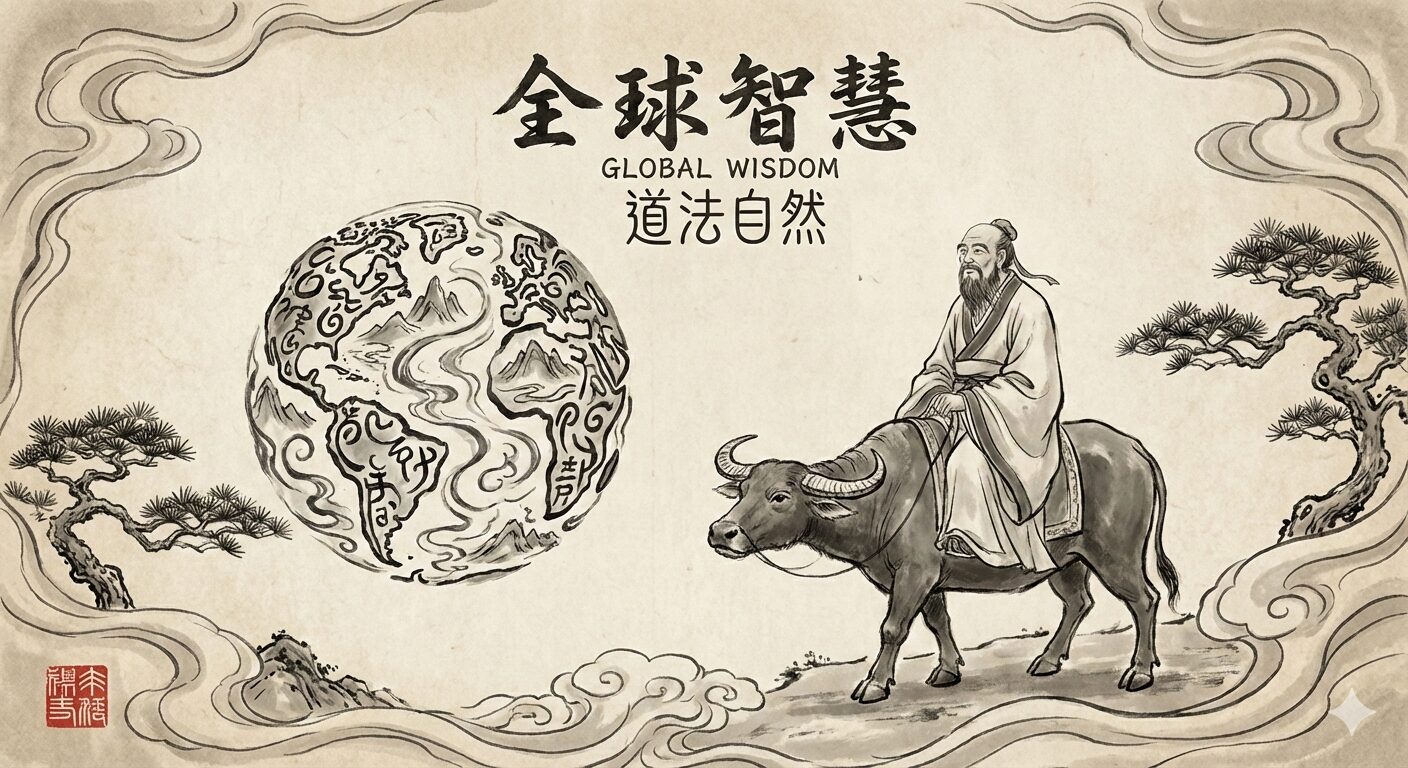
How timeless philosophies from around the world transform your everyday routines, relationships, and mindset.
Every culture throughout history has wrestled with the same questions. How should we live? What matters most? How do we find peace during suffering?
The answers they arrived at, through centuries of observation and lived experience, form a collective inheritance. Greek Stoics taught emotional resilience. Buddhist philosophy mapped the architecture of the mind. Indigenous traditions worldwide emphasized reciprocity with the natural world. West African communal ethics reminded us no individual thrives in isolation. Taoist thinkers pointed to the strength of yielding rather than forcing.
Each tradition offers a lens. When you hold several lenses together, the picture of a well-lived life comes into focus.
Mahatma Gandhi put the challenge clearly: “Live as if you were to die tomorrow. Learn as if you were to live forever.” That spirit of urgent, open learning is what integrating global wisdom demands. You become a humble student of traditions far older and broader than your own perspective.
Here are six frameworks drawn from global traditions, along with ways to practice them starting today.
“Nature does not hurry, yet everything is accomplished.” – Lao Tzu
Start Your Morning With Intention, Not Reaction
Marcus Aurelius began each day by mentally preparing for difficulty. In his private journal, he reminded himself he would encounter ungrateful, arrogant, and dishonest people, and none of them needed to disturb his inner peace. This was radical preparation, not pessimism.
Many Japanese traditions emphasize ichigo ichie, the idea that each moment is a once-in-a-lifetime encounter. When you combine Stoic mental preparation with this Japanese reverence for the present moment, your mornings transform.
Before your feet hit the floor each morning, take three slow breaths. Ask yourself one question: “What kind of person do I want to be today?” This small ritual, rooted in wisdom traditions East and West, anchors you before the world starts pulling you in every direction.
Practice Ubuntu in Your Relationships
The Southern African philosophy of Ubuntu translates as “I am because we are.” Your well-being is inseparable from the well-being of those around you. Archbishop Desmond Tutu described the concept this way: “A person with Ubuntu is open and available to others, affirming of others, does not feel threatened that others are able and good.”
In daily life, Ubuntu guides how you show up in the smallest interactions. Truly listen to a coworker instead of waiting for your turn to speak. Check in on a neighbor you have not seen in a while. Approach conflict with the understanding that the other person’s dignity matters as much as your own.
The Dalai Lama expressed this from a different angle: “If you want others to be happy, practice compassion. If you want to be happy, practice compassion.” Compassion in these traditions is an active, daily discipline. Not a passive feeling.
Embrace Wabi-Sabi and Release Perfectionism
The Japanese aesthetic concept of wabi-sabi centers on the appreciation of imperfection, impermanence, and incompleteness. A culture obsessed with optimization, filters, and flawless performance needs this counter-message.
The cracked pot holds its own beauty. The weathered wood tells a story. The unfinished painting invites reflection.
Applying wabi-sabi to daily life means releasing the grip of perfectionism. Send the email even though you rewrote the subject line four times. Accept that your home will never look like a magazine spread, and find warmth in that reality.
The Persian poet Rumi wrote, “The wound is the place where the Light enters you.” Your broken places are not failures. They are openings.
Find Stillness Through Meditation and Mindfulness
Nearly every wisdom tradition on Earth includes some form of contemplative practice. Hindu and Buddhist traditions developed sophisticated meditation techniques thousands of years ago. Christian mystics practiced contemplative prayer. Sufi poets found the divine through ecstatic inner focus. Indigenous cultures worldwide have used rhythmic chanting, vision quests, and silent observation to access deeper states of awareness.
You do not need an hour of silent sitting to benefit. Even five minutes of focused breathing, paying attention to the sensation of air entering and leaving your body, rewires your relationship with stress and reactivity.
Lao Tzu taught in the Tao Te Ching: “Nature does not hurry, yet everything is accomplished.” Stillness is not inactivity. Stillness is the ground from which intentional action grows.
Let the Concept of Dharma Guide Your Work
In Hindu philosophy, dharma refers to your duty, purpose, or righteous path. Each person has a unique role to play. Fulfilling that role with integrity is itself a spiritual practice. Work is a vehicle for meaning.
Bringing dharma into your professional life means asking deeper questions. Not “How do I get ahead?” but “How does what I do serve something larger than myself?” Bring full presence and care to your tasks, whether you lead a boardroom or sweep a floor.
Martin Luther King Jr. expressed this directly: “If a man is called to be a street sweeper, he should sweep streets even as Michelangelo painted, or Beethoven composed music, or Shakespeare wrote poetry.”
The Bhagavad Gita advises acting without attachment to results. The Stoics taught that virtue lies in effort, not outcome. When you stop tying your self-worth to external validation and commit to the integrity of the work itself, a quiet satisfaction takes root.
Honor the Seasons of Your Life
Many Indigenous wisdom traditions view life as a cyclical journey through seasons, not a linear climb toward success. There are seasons of growth and seasons of rest. Seasons of harvest and seasons of letting go. The Western tendency to push relentlessly toward productivity ignores this natural rhythm, leading to burnout and a persistent sense that you are never doing enough.
Honoring your seasons means giving yourself permission to slow down during grief or transition instead of forcing your way through. A fallow period, when nothing seems to be happening, is essential preparation for what comes next.
As Confucius advised: “It does not matter how slowly you go as long as you do not stop.”
Building a Personal Wisdom Practice
Integrating global wisdom into daily life works best when you turn passing interest into ongoing practice.
Read broadly and with intention. Pick up translations of the Tao Te Ching, the Meditations of Marcus Aurelius, the poetry of Rumi, or collections of African proverbs. Let these texts become companions. Keep a journal where you reflect on how a particular teaching showed up in your day. Over time, certain ideas will become part of your inner vocabulary.
Seek out conversations with people from different backgrounds. Wisdom lives in the stories your grandmother tells, in the traditions of communities different from your own, in the hard-won insights of people who have walked paths you have not. Approach these conversations with curiosity and humility.
Be patient with yourself. Wisdom traditions around the world agree on this point: transformation is gradual. The Japanese concept of kaizen, continuous small improvement, reminds you that lasting change does not come from dramatic overhauls. Show up day after day with the willingness to learn.
Ralph Waldo Emerson wrote: “The mind, once stretched by a new idea, never returns to its original dimensions.” When you open yourself to the global treasury of human wisdom, you expand your capacity for living. You develop a steadier inner compass and a deeper appreciation for the shared humanity connecting us all.
The teachings are there, waiting. They have waited for centuries. All that is required is the willingness to listen and the courage to let what you hear change how you live.
Leave a Reply